My co-bloggers and I love food. That’s probably pretty evident by the fact that we have a blog devoted to the subject. But we don’t just appreciate the visceral experiences of food—the tastes, sights and smells (which we certainly do)—we’re also fascinated by historical, cultural and (yes,
Alton Brown fans) scientific topics tied to food. Let’s just say we’re food nerds. We admit it proudly. So when we found out
Old Salem, a preserved, Colonial-era Moravian village in Winston-Salem, N.C., was having a cooking class based on 18th century Moravian recipes and cooking methods, we signed up pretty quickly.

For the food anthropologists among us, Moravian culinary traditions from the 18th and 19th centuries still influence the kitchens of the northwest Piedmont region of North Carolina to this day (primarily, Forsyth and Davidson Counties). For instance, there’s a chicken pie recipe (which is not a pot pie, thank you very much) that is only found in this particular region. And, of course, I’m convinced that Moravian sugar cakes laid the foundation for one of Winston-Salem’s more famous foods,
Krispy Kreme doughnuts, but that’s a post for another day.
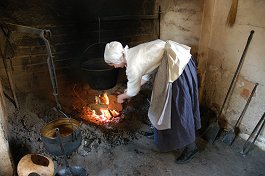
So, getting back to our little excursion back in time, let me share with you exactly what goes down during a period cooking class--a Holiday Hearthside Cooking Class, to be exact.
Foods Prepared:
Carolina Snowball
Sliced Peach Pudding
Marzipan Candies
Kitchen Tools, Utensils and Servingware:
Fireplace
Cast-Iron Cooker
Handmade Pottery
Straw Whisk
Balance (for measuring)
Soap and a Bucket of Room-Temperature Water (for handwashing)
Hand-forged Steel Forks and Knives
Recipes:
(You'll see that old recipes are anything but exact--at least compared to today's precise formulas.)
Carolina Snow Balls
Anna Paulina Schober (1805-1821) Salem, NC
Swell rice in milk, strain it off, and having pared and cored apples, put the rice around them, tying each up in a cloth; put a clove or cinnamon in each, and boil them well.
Sauce for Snow Balls
The Art of Cookery Made Plain and Easy by Hannah Glasse, 1774
Take a quarter pound of fresh butter melted thick, a glass of white wine, a little nutmeg, a beaten cinnamon, made very sweet with sugar; boil all up together and pour it into a bason [sic]. Send it to the table.
Sliced Apple Pudding
Kentucky Housewife, 1839
Beat six eggs till light, and stir them into a quart of sweet milk, with enough flour to make it a good batter, four ounces of butter, four of sugar, a glass of brandy and two powdered nutmegs. Pare and slice very thin from the cores half a dozen well-flavored apples, and put them in the batter, stirring and mixing them evenly through it. Put it in a buttered dish, or pan, and bake it in a moderate oven. Eat it warm, with cold cream sauce, or butter and sugar, flavored with lemon. A peach pudding may be made in the same manner.*
What We Learned:
Human beings, regardless of century, find creative ways to cook efficiently and add interest to recipes.
Folks used to eat with the knife rather than the fork. The fork was only to hold down food while cutting, and was dangerously sharp.
Washing your hands in a communal wash bucket filled with tepid water is pretty disturbing to those of us who prefer not sharing germs with others.
It takes a while for the 21st century palate to adjust to foods with little salt or sugar.
A marzipan candy can be a metaphor for the life of whomever is making it. (I have to say, this is my philosophy, not that of the Moravians.)
I crack under pressure and cannot whisk eggs properly or pare an apple quickly when others are watching. Michelle and Jason are pros at it all!
I’m very thankful for ovens and microwaves and hot water and whisks that aren’t made of straw … and about a hundred other things.
Every cooking class should be taught by someone in costume. It just helps; I don’t know why. Ok, it doesn’t really help—I just like seeing people in costume.
*We actually used peaches in our class